


5 Symptoms People Over 40 Ignore (But Shouldn't)
Updated on Mar 18, 2026


Medically reviewed by Dr. Sara Alisha Khan, MD, PGDMLE— Written by Dr. Dominic Gartry, MD
Updated on Mar 18, 2026
Table of contents
- 1. The Afternoon Energy Crash That Won't Quit
- 2. "Brain Fog" That Makes You Feel Like a Different Person
- 3. Slower Recovery From… Everything
- 4. Sleep That Doesn't Recharge You
- 5. A General Feeling of "I Just Don't Feel Like Myself"
- So What's Actually Going On?
- Can You Do Anything About It?
- What We Formulated at Omre (And Why)
- One More Thing Worth Mentioning
- The Bottom Line
Most people over 40 have said some version of this:
"I'm just tired. It's probably stress."
"My memory isn't that bad. I just forgot where I put my keys."
"I don't sleep as well anymore. That's normal, right?"
Here's what concerns me. Not the symptoms themselves. But how quickly we explain them away. We chalk them up to busy schedules, bad sleep, or "just getting older." And in doing so, we ignore what our body is actually trying to tell us.
After years of studying cellular health and aging, I can tell you, these aren't random complaints. They often share a common root cause that most people have never heard of.
Let's walk through five of the most commonly dismissed symptoms. And more importantly, what may actually be driving them.
1. The Afternoon Energy Crash That Won't Quit

You wake up fine. Maybe even good. But somewhere between 1pm and 3pm, you hit a wall. Not sleepy, exactly. More like your battery just… drops to 20%.
Coffee helps for an hour. Then you're back where you started. Worse, actually, because now you're wired and tired.
Most people blame lunch, or poor sleep the night before, or just "their age." But here's the thing. This kind of predictable energy crash wasn't happening five or ten years ago. Something changed.
And it's probably not your lunch.
2. "Brain Fog" That Makes You Feel Like a Different Person
You walk into a room and forget why you're there. You read the same paragraph three times. You lose a word mid-sentence, a word you've used a thousand times.
This isn't early dementia. Not for most people. But it's also not nothing.
When your brain can't access the energy it needs, at the cellular level, processing speed drops. Focus becomes harder. You feel mentally sluggish in a way that's hard to explain to anyone who hasn't experienced it.
The frustrating part? Your doctor will probably say your bloodwork looks "normal."
3. Slower Recovery From… Everything
You used to bounce back from a tough workout in a day. Now it takes three. A bad night of sleep used to be annoying. Now it wrecks your entire week.
Even small things, a cold, a stressful week at work, a long flight, seem to knock you down harder and longer than they used to.
This isn't a willpower problem. Your cells' ability to repair and recover depends on specific biological processes. And those processes require fuel that your body produces less and less of as you age.
4. Sleep That Doesn't Recharge You
You're getting seven or eight hours. But you wake up feeling like you got four. Deep, restorative sleep, the kind where you wake up actually refreshed, has become rare.
Maybe you're waking up at 3am for no reason. Maybe you fall asleep fine but never feel rested. Either way, the quality has dropped.
Sleep is when your body does its heaviest repair work. When the cellular machinery responsible for that repair is underpowered, sleep becomes shallow. Your body goes through the motions without completing the job.
5. A General Feeling of "I Just Don't Feel Like Myself"
This is the hardest one to pin down. And the easiest one to dismiss.
You're not sick. You're not depressed (at least, you don't think so). But something is off. You don't have the same drive. The same sharpness. The same aliveness you remember having.
It's subtle. Gradual. Easy to rationalize. But deep down, you know, something has shifted.
So What's Actually Going On?
Here's where it gets interesting.
All five of these symptoms, the energy crashes, the brain fog, the poor recovery, the shallow sleep, the general "blah" feeling, may share a single underlying factor.
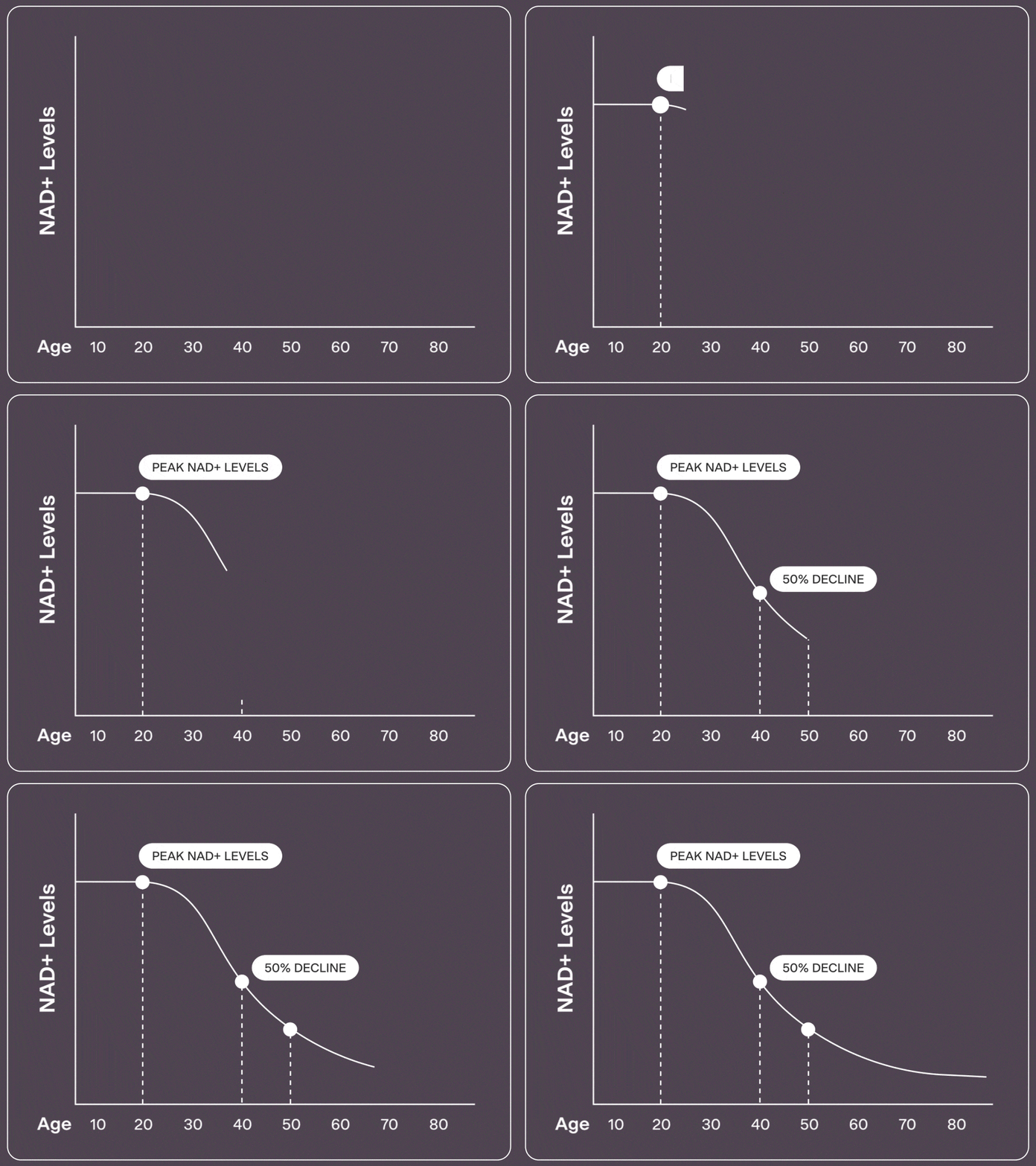
It's called NAD+. Short for nicotinamide adenine dinucleotide. It's a molecule found in every cell in your body. And it's essential for converting food into energy, repairing damaged DNA, and keeping your cells functioning properly.
The problem? Your NAD+ levels decline significantly as you age. Research suggests that by your mid-40s, your NAD+ levels may have dropped by 30–50% compared to your younger years.
Think about that for a moment. The molecule your cells depend on for energy, repair, and recovery, cut nearly in half. And no one told you.
This is why the symptoms above tend to appear gradually and cluster together. They're not five separate problems. They may be five expressions of the same cellular decline.
Can You Do Anything About It?
This is where the science has gotten genuinely exciting in recent years.
A compound called NMN (nicotinamide mononucleotide) is a direct precursor to NAD+. In simple terms, your body uses NMN to make more NAD+. Published research has shown that NMN supplementation can help replenish declining NAD+ levels, supporting energy production, cellular repair, and overall cellular health.
But, and this is important, not all NMN supplements deliver results. The difference comes down to three things: dosage, absorption, and what else is in the formula.
Most products on the market either underdose the NMN (using 100–125mg when research points to 500mg+ as the effective range), skip absorption enhancers entirely, or leave out synergistic compounds like resveratrol that activate the sirtuin pathways which actually use the NAD+ your body produces.
Without those elements working together, you're fueling an engine with no one behind the wheel.
What We Formulated at Omre (And Why)

This is exactly why we built our NMN + Resveratrol formula the way we did.
It combines 500mg of high-purity NMN (98% purity, confirmed by independent third-party lab testing) with 500mg of micronized trans-resveratrol, particle size reduced for 3.2x better absorption, plus 5mg of BioPerine®, a black pepper extract clinically shown to increase resveratrol bioavailability by up to 154%.
This isn't three random ingredients thrown together. It's a formulation designed around how the NAD+ pathway actually works: NMN provides the raw material, resveratrol activates the sirtuins that put it to use, and BioPerine ensures your body actually absorbs what you take.
Every batch is third-party tested with published certificates of analysis, something that's surprisingly rare in this industry. Our manufacturing follows GMP (Good Manufacturing Practice) standards. And we publish the test results because we believe you shouldn't have to take a company's word for what's inside the capsule.
One More Thing Worth Mentioning

Omre costs $62 per bottle. That works out to about $2 per day, less than the afternoon coffee most people are using to push through the fatigue we talked about earlier.
And every order comes with a 30-day money-back guarantee. No questions asked. If you don't feel a difference, you get your money back.
We built it this way because we believe the product speaks for itself once you give it a fair window. Two to four weeks is usually enough for most people to know.
The Bottom Line
If you're over 40 and you've been brushing off fatigue, brain fog, poor sleep, or that hard-to-explain feeling of "not being yourself", don't ignore it. And don't just accept it as "normal aging."
Your cells may simply need something they've been running low on for years.
Give them what they need. See what changes.

About the author
Dr. Dominic Gartry, MD
Table of contents
- 1. The Afternoon Energy Crash That Won't Quit
- 2. "Brain Fog" That Makes You Feel Like a Different Person
- 3. Slower Recovery From… Everything
- 4. Sleep That Doesn't Recharge You
- 5. A General Feeling of "I Just Don't Feel Like Myself"
- So What's Actually Going On?
- Can You Do Anything About It?
- What We Formulated at Omre (And Why)
- One More Thing Worth Mentioning
- The Bottom Line
- DMDaniel M.Verified BuyerReviewingNMN + ResveratrolI recommend this productRated 5 out of 5 stars2 years agoThis stuff changed my life!!!!!
Ok, this was recommended to me by my doctor - yes, you heard that right! My actual doctor told me to start taking this - This EXACT brand! Because it has the Resvirotrol (spelling?) also in it which she said was important.
Normally I don’t go for these types if things but I trust my doctor implicitly so I ordered it.
I’ve been taking two pills per day for one month now… let me tell you what’s been happening to my body…
I’m a 56 year old guy - I workout a lot - I’m a retired Airline Pilot and I’ve always been I pretty good shape but this stuff has rocketed me into a new sphere of training I though I had left behind 35 years ago! Yes, it’s that good!
Since taking this stuff my workouts last 50% longer and they’re at least 50% more intense!!! I’m not exaggerating!!!!! Even my wife has noticed! I lift heavier, my hikes are way longer and I don’t experience DOMS afterwards.
Somehow I have more energy during the day and it lasts all day. Mind officially blown!!!
This stuff works! I am SO grateful that my doc recommended this to me… it’s not cheap! But I’ll be buying this forever!
BTW - I’m not paid or endorsed in any way by these guys or their company! I don’t know them in any way and I have zero connection to them other than getting my order in the mail from them. (Shipping was not extremely fast though - that sucked).
This stuff is amazing!!!!! Anyone reading this - try it! You can thank me later.
D.M.
- JOJohn O.Verified BuyerReviewingNMN + ResveratrolI recommend this productRated 5 out of 5 stars11 months agoJust Do IT - I Read The Book!
In 2019 a Harvard leading scientist named David Sinclair, PhD wrote a book called Lifespan - Why we age and why we don't have to. I saw him on have a discussion denoting he was the leading scientist researchin g aging. He indicated that he discovered how to stop aging; six month later in another presentation he indicated that he had discovered how to reverse aging. Unfortunately, the only product that the government allows to be sold is NMN + Resveratrol. David Sinclair takes four capsules each day. I've been taking it for almost three years now - like David I take four a day, even though the directions say two/day. Most people guess I'm 52 or 53; that just happened again three days ago. A dermatologist said my skin is that of someone who is 60. Drum roll... I am 70 years and 9 months old! This is a TRUE STORY!
omreusa11 months agoHi John, fantastic to hear about your incredible experience with our NMN + Resveratrol! Love that you're getting such positive feedback about your appearance - those age estimates are truly remarkable! Really appreciate you sharing your detailed journey and the specific observations you've experienced.
- CLCheryl L.Verified BuyerReviewingNMN + ResveratrolI recommend this productAge Range 55-64Gender FemaleHow Longevity Helped? More Energy, Easy dosingRated 5 out of 5 stars2 years agoRenewed Energy and Life Force
I was told I have autoimmune Hashimoto's in 2020 after I got COVID at 56 years old. I can't even begin to tell you how bone numbing and cell deep my fatigue was, and even worse, NOTHING helped. Not medication, doctors, handfuls of supplements, acupuncture, or Reiki. I could barely get off my couch or out of my bed just to purchase a few groceries , or take a shower. I thought that was going to be my life, forever, which dropped me into depression and a feeling of utter hopelessness. I researched and researched on my own and decided I'd give one more thing a shot, and that was OMRE's Resveritrol and NMN. Within 5 days of taking my first two pills, after being so ill for three years, I had the energy to get out of bed, take a shower, and I actually cooked myself a meal. Within two weeks, I could do that, AND mow my yard, or work a normal day without having to take a nap. Best of all, I actually WANTED to get up, where prior to taking the supplements, I didn't even want to wake up, let alone try to do anything more than just breathe. This supplement gave me a large portion of my life back. I still have a few “down days†a month because Hashimoto's doesn't just go away, but those days are days where all I do is take a nap, and resume my normal life straight away after it. Yes, they are on the expensive side (and being on a low fixed retirement income, hard to afford), but the benefits far, far outweigh the price. I couldn't recommend trying something more than I do this…
- DNDewald N.Verified BuyerReviewingNMN + ResveratrolI recommend this productRated 5 out of 5 stars2 years agoPromising results
Started using this after experiencing painful Gout symptoms at 40. After about a month of using this, no trace of the Gout symptoms anymore.
- DBDevin B.Verified BuyerReviewingNMN + ResveratrolI recommend this productRated 5 out of 5 stars3 years agoGood quality
I was looking for a Resveratrol and NMN supplement combo and this product has a high dose of each and both are 98% purity which is ideal. Also, it doesn’t contain magnesium stearate which is an added bonus.